
Connected Devices & IoT
Smart Treadmill Software: From Prototype to Connected Fitness Platform
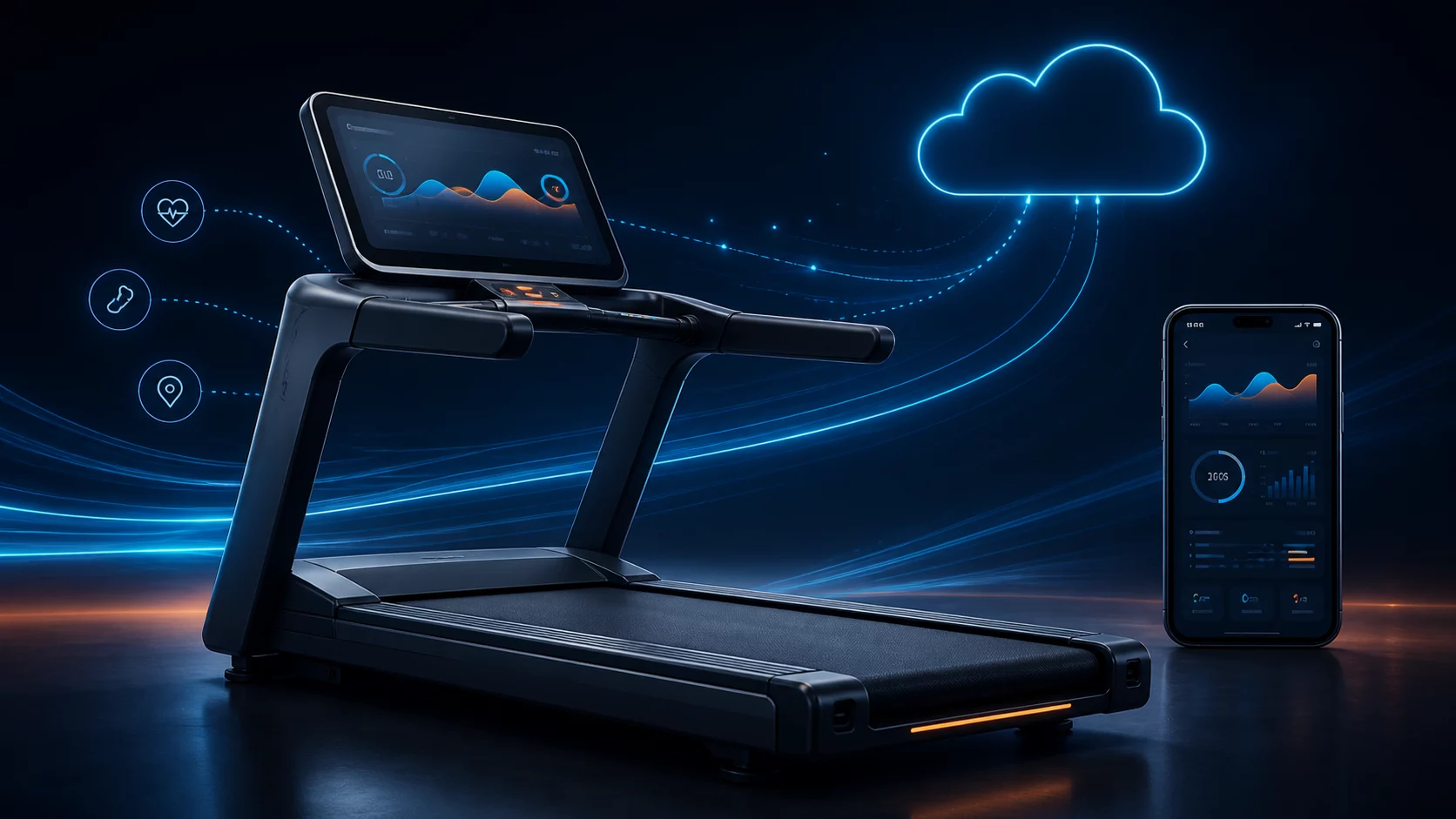
Technical product architecture for the smart treadmill, covering device display, secure motor control, mobile application, cloud services, telemetry and OTA layers.
Short answer
Turning your treadmill into a screen-to-cloud product
Smart treadmill software is not just an interface that displays speed and time. Product; it is a connected fitness ecosystem where touch device screen, real-time control card, sensors, user account, training history, mobile application and remote device management work together. In the first prototype, the goal is to validate the end-to-end experience by simulating speed, incline, heart rate, distance and calorie data, even if the real hardware is not ready.
Device architecture: separating HMI and critical control
Runs 7–10 inch Android or Linux panel user interface in the proposed architecture; Time-critical tasks such as motor, tilt, and emergency stop remain on a separate STM32 or ESP32 class microcontroller. The display and control card communicate with a versioned command protocol via UART, RS485 or CAN. In addition to START, STOP, SET_SPEED and SET_INCLINE commands, instantaneous speed, current, temperature, safety switch and error codes are displayed on the screen as telemetry. Locking the Android app should not affect engine safety; the control card must independently implement connection timeout, upper limits and physical emergency stop rules.
Display, mobile application and cloud services
The device app opens in kiosk mode; it offers quick start, program selection, speed/incline control, live metrics and workout summary. The user can log in from his phone with a QR code. The mobile app manages past workouts, goals and device pairing. On the cloud side, there is the Device API, user service, training service, MQTT broker, WebSocket gateway and management panel. Device identity is verified by certificate or secure key; Training records can be transferred via REST and live status can be transferred via MQTT.
Offline operation, data model and OTA
The treadmill should be able to continue basic exercise even without internet. The local database stores incomplete session, user preferences, and telemetry waiting to be sent; When the connection arrives, synchronization is made with idempotent records. The underlying data model consists of the Device, User, WorkoutSession, MetricSample, Program, FirmwareRelease, and DeviceEvent entities. OTA updates require signed package, phased deployment, version rollback, and secure state that prevents exercise launch during update.
Working prototype and demo coverage
The sales demo can be prepared with an Android tablet, ESP32-based simulator and web management panel. Physical buttons or potentiometer emulate speed and tilt sensor; Commands on the screen are responded to in the simulator. The demo scenario includes QR login, jogging, live heart rate, disconnection, workout summary, sync to cloud and view device status in admin panel. Thus, not only the screen design, but also the device software and operation infrastructure are shown to the manufacturer.
Testing and transition plan to production
Protocol parsers are verified by unit tests, device connection is verified by hardware loop tests, and workout flow is verified by automation tests. Long-time operation, sudden power outage, network loss, corrupted packet, sensor drift and control card reboot scenarios are also tested. Watchdog, crash reporting, remote log collection, device fleet groups and gradual firmware distribution are added during the production phase. Relevant hardware standards for motor control and electrical safety must be verified separately with the manufacturer and the authorized testing laboratory.
Business value to show in presentation
The product offering must progress through three layers: a better training experience for the user, a premium product family for the manufacturer, and remote diagnostics for the service team. Metrics that will be displayed are number of active devices, completed workouts, error rate, firmware distribution and maintenance alerts. This approach turns a standard treadmill into a connected product with a user account, software updates, and mobile experience.
Frequently asked questions
Should the engine be controlled directly from the Android app?
No. Time-critical and safety-critical motor control should remain on a separate microcontroller; Android or Linux must have an HMI layer that sends screen-controlled commands.
Can a demo be prepared without a real treadmill?
Yes. The ESP32 or desktop simulator provides verification of display, cloud and admin flows by generating speed, slope, sensor and error conditions.