
Connected Devices & IoT
Industrial HMI Panel Software: Prototype, Edge and Cloud Architecture
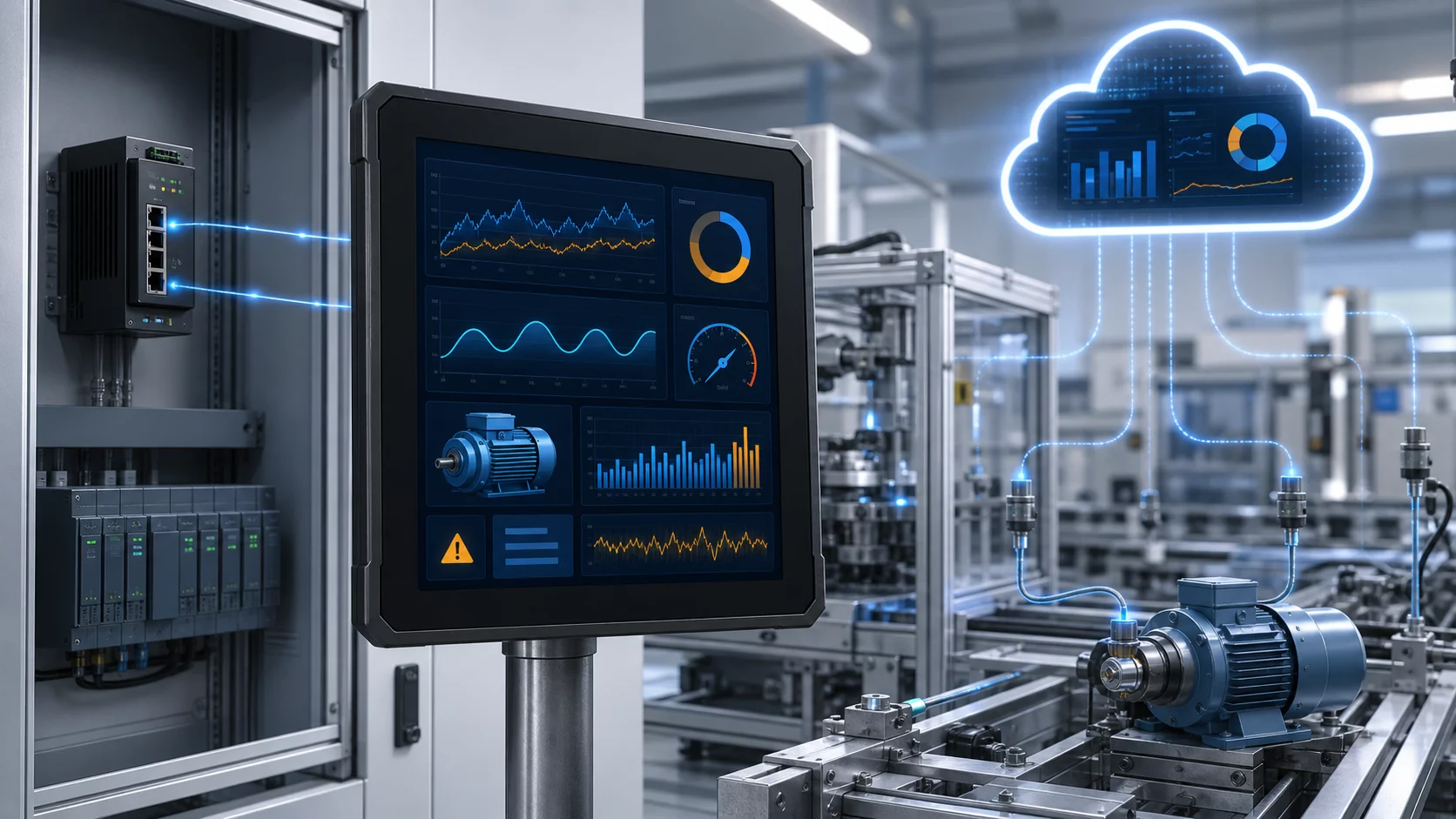
Industrial HMI approach combining PLC and sensor data with operator display, alarm management, edge gateway, history graphics and remote maintenance panel.
Short answer
Making machine status understandable and safe
Industrial HMI; it is a touch interface that displays temperature, pressure, engine speed, production quantity and alarm conditions to the operator. In the modern approach, HMI is not just a PLC screen; it expands with edge recording, remote service, recipe management and fleet analytics. The first prototype should target a single machine cell operating via a real PLC or Modbus simulator.
PLC, edge gateway and HMI responsibilities
The deterministic control loop and safety functions of the machine remain with the PLC or safety controller. The HMI transmits operator commands to the PLC with authorization and limit controls. Edge gateway reads Modbus RTU/TCP, OPC UA, CAN or manufacturer protocol and converts it to common tag model; buffers the data locally and sends it to the cloud. The HMI should not have unlimited access to raw devices in the control network, but should work via a defined command surface.
Tag model, alarm and historical data
For each measurement, tag ID, data type, unit, reading range, valid limit and quality information are defined. The alarm model keeps threshold, severity, delay, confirming operator and closing time. High-frequency data is sampled on the edge; only the required resolution is sent to the cloud. Recipe changes must be versioned, reversible and authorized. The graph display should show trends for the operator to decide on, rather than a pile of raw data.
Offline-first working and cyber security
The machine must continue production safely without internet or cloud. The Edge database stores telemetry and alarm events, synchronizing them with the sequence number when the connection arrives. IT and OT networks should be separated; remote access should be off by default. Device identity, certificate, role-based operator authority, audit trails, signed update and allowed connection lists are the basic layers of defense.
Prototype and live demo scenario
Demo can be prepared with 7–10 inch panel, Modbus simulator and web maintenance panel. The simulator produces engine speed, temperature, pressure and production meter. The operator changes the set value, a temperature alarm occurs, the alarm is confirmed and the event is written to the history. The HMI continues to operate when the network is interrupted; When the connection returns, the missing telemetry is transferred to the admin panel. The inability of the unauthorized user to change the critical parameter is also indicated.
Verification and transition to field
Tag mappings are compared with the simulator and real PLC; Limit, scale and unit errors are tested. Soak test, power outage, disk full, network storm, sensor break and PLC restart scenarios are applied. Usability testing covers glove, distance vision, noise and low light conditions. All machine safety-related functions must be separately verified by the manufacturer within the framework of risk analysis and relevant industrial standards.
Different machine families from a single platform
During productization, screen components, tag templates, alarm engine, device ID, OTA, log and admin infrastructure can be kept common. The customer-specific section is the protocol adapter, machine screens and business rules. Faster commissioning, remote fault diagnosis, controlled recipe management and monitoring of multiple machines from a single panel should be highlighted in the presentation.
Frequently asked questions
Does HMI replace PLC?
No. HMI is the operator interface; Real-time machine control and safety functions must remain in the PLC or appropriate controller.
Should cloud connectivity be mandatory for production?
No. Basic control and local HMI functions must work offline; should be used for cloud monitoring, reporting, fleet management and authorized remote service.